RiverSentinel was designed for environmental monitoring teams that need faster incident detection than manual sampling can provide, but also need evidence quality high enough for response workflows. The project built an autonomous buoy mesh with edge validation, consensus-based escalation, and regulatory-ready event packaging.
Problem and deployment context
Manual spot checks were too sparse for dynamic contamination events. Teams needed:
- continuous sensing,
- high availability under storms,
- lower false escalations,
- traceable, audit-friendly event records.
The challenge was balancing sensitivity and trust. Over-sensitive systems drown teams in noise. Under-sensitive systems miss incidents.
Mesh node design
Each buoy node measured:
- pH,
- turbidity,
- conductivity,
- temperature,
- power and enclosure health.
Concretely, a node was an ESP32-class MCU driving industrial probes over analog/RS-485: an ISE pH probe, an optical (nephelometric) turbidity sensor, a toroidal/contacting conductivity probe, and a waterproof temperature probe, plus a battery/solar charge monitor and an internal humidity sensor for enclosure health. The probes are the expensive, drift-prone part, so the firmware treated every reading as suspect until validated rather than trusting raw ADC values.
The radio layer was LoRa in a store-and-forward mesh: buoy nodes relayed for neighbors so a node out of direct range of shore still reached the network. The shore relay node handled LoRa-to-LTE uplink and buffered OTA updates for low-connectivity windows.
Data path
The end-to-end path was deliberately simple and buffered at every hop, because connectivity on open water is the least reliable part of the system:
buoy sensors -> per-node edge sanity check -> LoRa mesh hop(s)
   -> shore relay (buffer) -> LTE uplink -> Rust validation core (Pi CM4)
   -> escalation engine + audit store -> operator dashboard / public feed
Every hop can buffer and retry, so a lost LTE window or a temporarily unreachable buoy degrades latency rather than dropping data.
Environmental hardening
Hardware hardening included:
- anti-corrosion connector strategy,
- enclosure venting + drip path design,
- maintenance-friendly probe mounts,
- aggressive watchdog and self-heal logic.
These choices mattered more than raw sensor specs for real uptime.
Rust validation core
The edge validation engine on Pi CM4 enforced a multi-stage quality gate:
- per-sensor sanity checks,
- drift and slope anomalies,
- context enrichment (rain/storm markers),
- cross-node consensus before escalation.
Consensus logic reduced false events caused by local disturbances and probe artifacts.
Escalation model
Event severity levels were aligned with response procedures:
- Level 1: monitor,
- Level 2: verify with nearest team,
- Level 3: immediate response workflow,
- Level 4: regulatory escalation and public feed update.
The system produced structured incident packets with confidence, supporting evidence, and recommended action steps.
Data governance and traceability
For agency adoption, traceability was mandatory. Every event carried:
- source node signatures,
- validation rule versions,
- enrichment inputs,
- processing timestamps.
This made post-incident review and legal defensibility much stronger.
Pilot outcomes
Observed pilot benefits:
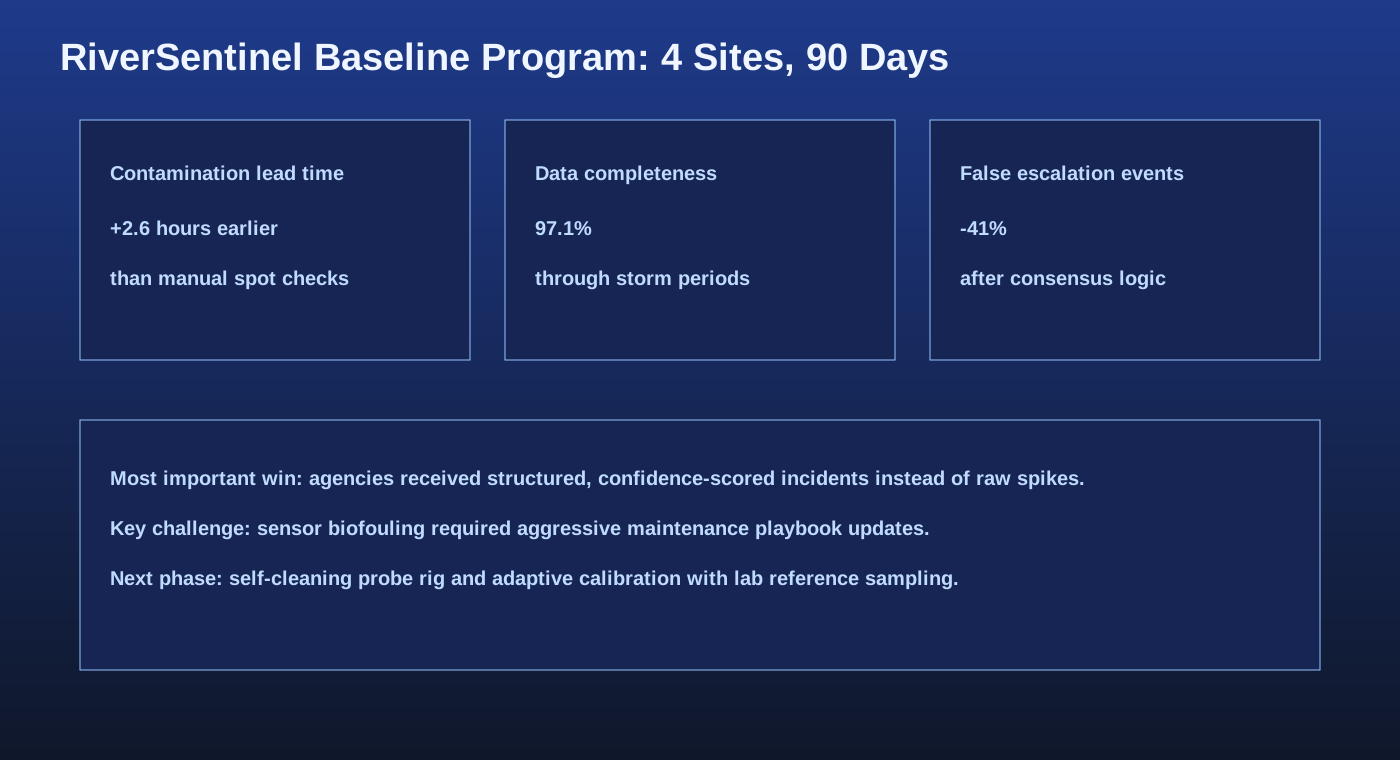
- contamination lead time improved by about 2.6 hours,
- data completeness stayed around 97.1 percent through storms,
- false escalations reduced 41 percent after consensus tuning.
These figures are from a single author-run pilot and are self-reported, not a controlled multi-site study. They are best read as directional: the lead-time and completeness figures are compared against the prior manual spot-check cadence, and the false-escalation figure is a before/after on the same nodes once cross-node consensus was enabled. There was no independent baseline instrumentation, so treat the exact percentages as approximate observations rather than measured statistics.
Field teams reported that response quality improved because incidents came pre-ranked with confidence and context.
Key failure points
Issues encountered:
- biofouling accelerated at one site,
- one LTE relay had intermittent backhaul instability,
- early calibration schedule was too conservative.
Fixes:
- updated cleaning cadence and probe shield geometry,
- relay reconnect strategy with smarter backoff,
- adaptive calibration triggers based on residual drift.
Why this is special
RiverSentinel stands out because it merges environmental sensing, robust edge validation, and operations-grade escalation design. It is not "just an IoT graph"; it is an incident response system with evidence quality built in.
Next phase
Future work:
- self-cleaning probe hardware,
- multi-site adaptive thresholds by seasonal patterns,
- stronger contamination source attribution model,
- public transparency dashboard with uncertainty communication.
If you build environmental networks, prioritize trust architecture as much as sensor architecture. The decision pipeline is where most real-world value is created.
Sources
- This is a first-person special-project report; the design decisions and pilot figures are the author's own and are self-reported rather than externally validated.
- LoRa Alliance — LoRaWAN specification and regional parameters (for the radio/relay design context): https://lora-alliance.org/resource_hub/
- US EPA — Water Quality Monitoring guidance (background on parameters such as pH, turbidity, conductivity, and temperature): https://www.epa.gov/waterdata
- Imported from the previous version of the site (gaborl.hu). Original publication around 2024-08-20.
Update history
- — Adopted from previous gaborl.hu (Hugo) site via legacy import.